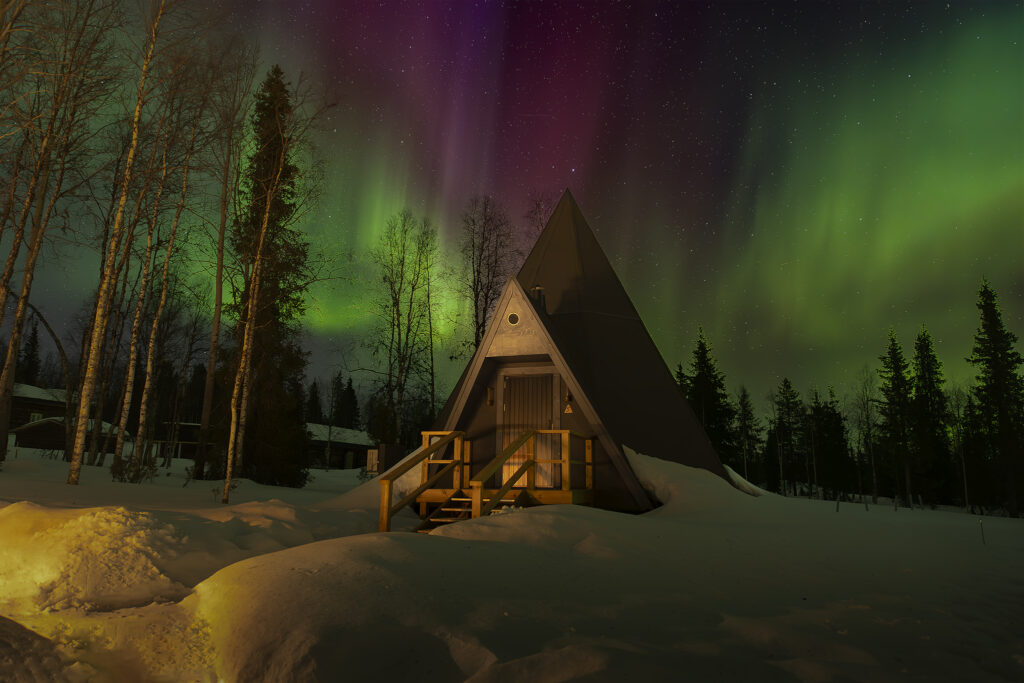
January is deep winter in Finnish Lapland. The festive weeks are over, the days slowly lengthen after midwinter, and the long nights still give plenty of time to watch for the aurora. At Nivunki Village, January in Lapland is one of the quietest months of our season, and for many guests, that quiet is exactly the point.
This guide covers what each winter month is like in Lapland, with a close look at what January specifically offers: the conditions, the activities, the cold, and what to pack. Whether you are planning your first Arctic trip or returning for a deeper experience, here is what to expect.
Is January a good time to visit Lapland?
Yes. January is one of the best months for a genuine Arctic winter experience. The festive crowds of December have gone, the snow is well established, and the long nights give excellent conditions for aurora watching. Is January a good time to visit Lapland? For anyone who values stillness and space, the answer is straightforward.
At Nivunki Village, our adults-only glass kotas sit beside a lake roughly 20 km from Muonio, away from the light pollution of resort centres. January 2027 falls within our winter season, which runs from 14 November 2026 to 3 April 2027. The pace is unhurried. There are no crowds, no noise drifting from a neighbouring bar. Just the lake, the forest, and the cold air above.
For a broader picture of how January compares to other months, see our month-by-month winter guide.
Daylight after the midwinter turn
The winter solstice falls in December, and by January the days have begun to lengthen again. The change is gradual at first, but it is real and noticeable across the month. January in Finnish Lapland carries a particular quality of light: low, blue-tinted, and brief, arriving late and leaving early.
That brevity is not a drawback. It means the sky is dark for much of the day, which creates long windows for aurora activity. Mornings arrive with a soft glow over the frozen lake, and the light stays close to the horizon even at its height. For many guests, this is one of the defining qualities of a Lapland winter visit.
The slow return of light after midwinter also gives January a sense of transition. Winter is still fully present, but the season has turned its corner.
Northern lights in January
Northern lights conditions in Lapland in January are among the most favourable of the season. Finnish Lapland sees auroras on around 200 nights a year, which works out to roughly every second clear night. The primary factor is sky clarity: on a clear, dark night, the aurora can fill the sky above the lake in shifting curtains of green and, occasionally, violet.
The best window for aurora activity is generally between 21.00 and 01.00 local time. January nights are long, which means that window sits within a sky that has been dark for many hours. Can you see the Northern Lights in Finland in January? Yes, and the conditions are good. But the aurora does not appear on schedule, and we never promise sightings.
What we can offer is the right setting. Our glass kotas face the lake with no light pollution between you and the sky. For guided experiences, the Aurora Trek in Nivunki runs on Monday, Wednesday, Friday and Sunday evenings at 20.00, lasting around 2.5 hours. For more on planning around the aurora, read our guide to seeing the Northern Lights in Finnish Lapland.
How cold is Lapland in January?
How cold is Lapland in January? Cold enough to take seriously, and cold enough to be remarkable. The Finnish Meteorological Institute notes that temperature differences between regions of Finland are greatest in January, with a gap of around 12 °C between south and north. In central Lapland, the difference between the mean temperatures of the coldest and warmest months spans 28 °C.
Layering is the foundation of staying comfortable. A moisture-wicking base layer, an insulating mid-layer, and a windproof and waterproof outer shell form the core system. Hands, feet and face need the same attention. For a detailed approach to how to dress for the cold, our layering guide covers everything from base layers to boot liners.
At Nivunki Village, premium winter clothing is included with every stay. That means guests step outside already equipped for the conditions, without needing to source or transport specialist gear from home.
Snow in January
Snow in Finnish Lapland is reliable and deep by January. Thermal winter typically begins in mid-October in Lapland and lasts around 200 days, so by January the snowpack is well established and still building. Snow depth peaks around mid-March, averaging 60 to 90 cm in eastern and northern Finland.
In January the landscape is fully white. Frozen lakes carry a thick layer of snow, the forest trails are set, and the conditions for snowshoeing, skiing and snowmobile travel are consistent. This is the Arctic winter that photographs rarely capture fully: still, dense and genuinely cold underfoot.
Things to do in Lapland in January
What to do in Lapland in January is one of the most common questions we hear, and the answer at Nivunki Village is varied. The full winter activities in Finnish Lapland programme runs through January, with guided experiences on most days of the week.
Husky and reindeer
The Half Day Husky Adventure runs on Monday, Tuesday, Thursday and Saturday at 09.30 and 13.30. It covers 18 km over three hours and includes a stop at a kota for salmon soup. Drivers must be at least 18. For a sense of what the experience involves, our guide on what to expect on a husky safari is a good starting point.
The Reindeer Ride in the Wilderness runs on Monday, Wednesday and Saturday at 10.00, covering 4 km over two hours. Around 120 reindeer live in the reindeer fence at Nivunki, and the ride connects guests directly to the reindeer herding culture that has shaped this land for generations. More on the history behind that is in our piece on reindeer in Lapland.
Snowshoe, skiing and snowmobile
The Scenic Snowshoe Trip to Fell Nivunki runs on Monday, Wednesday, Friday and Sunday at 11.00. The four-hour route begins with a snowmobile sleigh ride and includes a kota stop for a hot drink. The Väärti Trail, Forest Ski Experience lasts 2.5 hours and runs on request. No prior skiing experience is needed; a guide teaches the technique on the day.
For snowmobile travel, Frosty Trails covers 20 km over two hours and runs on Monday, Wednesday, Friday and Sunday at 13.30. Snowmobile drivers must be at least 18. Complimentary snowshoes are included with every stay for guests who prefer to explore independently.
Browse our winter programme for the full list of departures and activity details.
January at a glance
The table below summarises what to expect from January travel in Lapland across the key areas.
| Topic | What to expect |
|---|---|
| Light | Short days, slowly lengthening after the December solstice |
| Aurora | Long nights; best chances usually 21.00–01.00 on clear nights |
| Cold | Deep winter; FMI notes the greatest south-to-north temperature difference occurs in January |
| Snow | Winter well established; depth still building toward its mid-March peak |
| Activities | Husky, reindeer, snowshoe, forest skiing, snowmobile, aurora |
| Clothing | Premium winter clothing included at Nivunki Village |
Frequently asked questions
Is January a good time to visit Lapland?
January is one of the strongest months for a deep Arctic winter experience. The post-December quiet means fewer visitors, the snow is consistent, and the long nights create good conditions for aurora watching. For travellers who want stillness, space and genuine winter, January travel in Lapland delivers all three without the festive season’s pace.
How cold is Lapland in January?
Very cold. The Finnish Meteorological Institute records the greatest temperature gap between southern and northern Finland in January, around 12 °C. In central Lapland, the swing between the coldest and warmest months reaches 28 °C. Layering well is essential. At Nivunki Village, premium winter clothing is included, so guests are equipped from the moment they step outside.
Can you see the Northern Lights in Finland in January?
Yes. Finnish Lapland sees auroras on roughly 200 nights a year, around every second clear night. January’s long, dark nights give extended viewing windows, with activity most likely between 21.00 and 01.00. Clear skies are the main variable. We never guarantee sightings, but our lakeside location away from light pollution gives you the best possible conditions.
What can you do in Lapland in January?
At Nivunki Village in January, the programme includes husky adventures, reindeer rides, snowshoe trips to Fell Nivunki, forest skiing on the Väärti Trail, snowmobile tours, and guided aurora treks. Complimentary snowshoes and the sauna with panoramic windows are available to all guests throughout their stay. Most guided activities run several days a week.
January at Nivunki Village
Lapland in January 2027 at Nivunki Village is quiet in the best sense. The season runs until 3 April 2027, and January sits at the heart of it: snow deep, nights long, the lake frozen flat. Our adults-only glass kotas are 30 m², beside the water, and away from the light pollution that works against aurora watching.
Breakfast, premium winter clothing, complimentary snowshoes and the sauna are included. The rest of the programme, from the Half Day Husky Adventure to the Aurora Trek in Nivunki, is there when you want it, and quiet is there when you do not. That balance is what winter in Lapland at Nivunki is built around.
When you are ready to think through the details, plan your January stay with our team. We are glad to help.