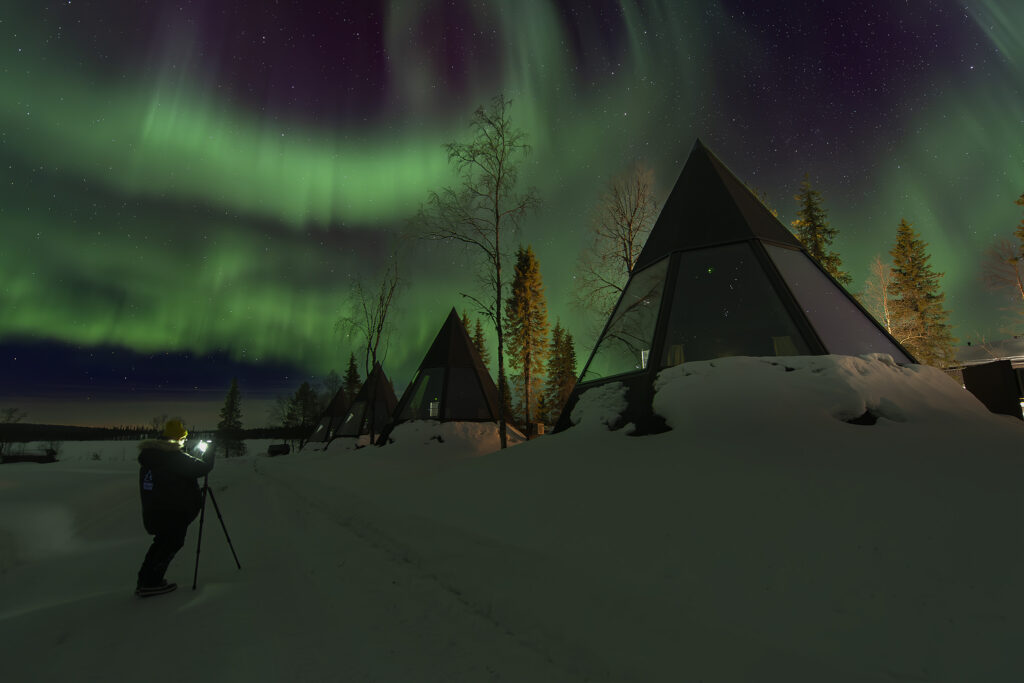
At Nivunki Village, winter runs from 14 November 2026 to 3 April 2027, and every month of it feels different. Early winter brings long, dark nights for the Northern Lights. Midwinter brings kaamos and the deepest quiet of the year. Late winter brings bright days and one of the most active aurora periods. Here is what each month is like, and how to choose yours.
Nivunki Village is an adults-only glass kota village beside a lake, about 20 km from Muonio and north of the Arctic Circle. This guide follows our season month by month, covering daylight, aurora conditions, cold and what you can do, so you can choose the weeks that suit you best.
What is winter like in Finnish Lapland?
Winter in Finnish Lapland is a season of snow and long nights, followed by a slow return of light. The aurora season runs from late August to early April, and according to Finavia the Northern Lights can be seen in Lapland on about 200 nights a year, which is every second clear night. Clear skies, not the calendar, decide most sightings.
The light itself changes through the season. Around midwinter, places above the Arctic Circle experience kaamos, the polar night, when the sun stays below the horizon. By late winter, days are roughly half bright sun and half starry night. At Nivunki Village you experience both from the same lakeside setting, away from the light pollution of resort centres.
What draws people here is the pace. The forest is quiet, the lake lies still under snow and ice, and the day follows light and darkness rather than a timetable.
Lapland winter at a glance
The table summarises each month of our winter season.
| Month | Daylight | Aurora | At Nivunki Village |
|---|---|---|---|
| November | Short days, long nights | Within the aurora season | Season opens on 14 November |
| December | Darkest month; kaamos above the Arctic Circle | Long nights to watch | Festive weeks, blue twilight by day |
| January | Short days, slowly lengthening | Long nights to watch | Deep winter, full activity programme |
| February | Days lengthening | One of the most active periods | Ice fishing trips to Lake Särkijärvi begin |
| March | Bright days, dark nights | One of the most active periods | Light and auroras on the same trip |
| Early April | Long, bright days | Season ends as nights brighten | Last days of the season, until 3 April |
Lapland in November
November is when our season opens. From 14 November, the glass kotas, the sauna, the restaurant and our guided winter activities are open for the winter.
Snow conditions in November vary from year to year, so we never promise a white landscape on a particular date. What November does offer is long nights within the aurora season and a quiet start to winter.
Is Lapland worth visiting in November? Yes, if you value stillness and long evenings more than guaranteed snow. Guided options such as the Aurora Trek in Nivunki and the Aurora Snowmobile Tour are part of the winter programme from the start, so a clear night never goes to waste.
Lapland in December
December is the darkest month of the year, and for many of our guests that darkness is the point.
Around midwinter, places above the Arctic Circle experience kaamos, when the sun stays below the horizon. It is rarely pitch black: blue twilight is typical during the day, and the moon and the snow add light of their own. On 22 December, the sun rises for a few minutes on the Arctic Circle, marking the turning point of the year.
For aurora watching, December means long nights. From a glass kota you can keep an eye on the sky without going outside, and when it clears, our guides head out on aurora treks and snowmobile tours. December also brings the festive weeks, and Nivunki Village offers an adults-only, quieter way to spend Christmas and New Year in the Arctic.
Lapland in January
January is deep winter. The days are short but slowly lengthening after the midwinter turn, and the nights stay long.
The Finnish Meteorological Institute notes that temperature differences between regions in Finland are greatest in January, at about 12 °C between the south and the north. January is a month to dress for properly, which is why premium winter clothing is included in every stay at Nivunki Village.
January suits travellers who want the most concentrated version of an Arctic winter: the Scenic Snowshoe Trip to Fell Nivunki, the Reindeer Ride in the Wilderness and long evenings in our sauna with panoramic windows.
Lapland in February
February is when the light starts to return, and the change is easy to feel.
Days lengthen through the month while the nights stay long. February also opens what Visit Finland describes as one of the most active aurora periods of the year, February to March. Bright days for husky and snowmobile trips, then dark evenings for the aurora, make February one of the most balanced months of our season.
From February, the Winter Fishing Trip to Lake Särkijärvi joins the programme, along with the Arctic Adventure, a snowmobile expedition with ice fishing. Both run from February to April.
Lapland in March
March brings bright days and dark nights together, which often surprises first-time visitors.
Late winter days are roughly half bright sun and half starry night, and March sits within the active February to March aurora period. You can spend the afternoon on the Snowmobile Adventure to Old Mill Äkäsmylly, then step outside after dinner to watch the sky. If you want daylight and auroras on the same trip, March is a strong answer to the question of the best time to visit Lapland.
Lapland in early April
Our winter season ends on 3 April 2027. In early April the nights brighten quickly and the aurora season draws to a close, while the days are long. With late-season ice fishing still on offer, the first days of April make a quiet ending to the winter.
How cold is Lapland in winter?
Cold is part of a Lapland winter, and it is easier to enjoy when you are dressed for it.
The Finnish Meteorological Institute’s figures give a sense of scale. In January, the temperature difference between southern and northern Finland is about 12 °C. In central Lapland, the gap between the mean temperatures of the coldest and warmest months is 28 °C.
The practical answer is layers: a base layer that keeps moisture away from your skin, an insulating mid layer and a windproof outer layer, plus warm boots, gloves and a hat. You do not need to pack a full Arctic wardrobe for Nivunki Village. Premium winter clothing is included in your stay, and so are snowshoes.
Which month suits you best?
The right month depends on what you want most from the trip.
- For the darkest aurora nights: December or January
- For a quieter start to the season: late November
- For light and auroras together: March
- For ice fishing on Lake Särkijärvi: February to early April
- For the festive weeks: December
- For a balance of daylight and active auroras: February or March
Still deciding? Talk to our team about dates and we will help you match the month to the trip you have in mind.
Frequently asked questions
What is the best time to visit Lapland in winter?
It depends on what you want most. February and March combine returning daylight with one of the most active aurora periods. December and January bring the longest nights and the polar night. November offers a quieter start. The Nivunki Village season runs from 14 November 2026 to 3 April 2027, so every one of these options is open to you.
Is Lapland worth visiting in November?
Yes, with the right expectations. November sits well inside the aurora season and the nights are long, but snow conditions vary from year to year. If you are drawn to stillness and a quiet start to winter, November is a good month to come. Our season opens on 14 November, with glass kotas, sauna and guided activities ready from the first day.
How cold is Lapland in December?
Cold enough to dress in proper layers. Temperatures vary from year to year and from day to day, so plan for winter conditions rather than a single number. What matters most is preparation: warm layers, boots, gloves and a hat. At Nivunki Village, premium winter clothing is included in your stay, so you can leave the heaviest gear at home.
How cold is Lapland in January?
January is deep winter. The Finnish Meteorological Institute notes that temperature differences between southern and northern Finland are greatest in January, at about 12 °C, and that in central Lapland the gap between the coldest and warmest months is 28 °C. Dress in layers and cover exposed skin. At Nivunki Village, premium winter clothing is included in every stay.
Is it dark all day in Lapland in December?
Not completely. Around midwinter, places above the Arctic Circle experience kaamos, when the sun stays below the horizon, but it is rarely pitch black. Blue twilight is typical during the day, and the moon and snow add light. On 22 December, the sun rises for a few minutes on the Arctic Circle, and from there the light begins its return.
Winter at Nivunki Village
Our winter season runs from 14 November 2026 to 3 April 2027 and covers every month in this guide. Nivunki Village sits beside a lake about 20 km from Muonio, away from the light pollution of resort centres, so on a clear night the aurora has the dark sky to itself.
Each glass kota is 30 m² for one or two guests, with a king-size bed, a bathroom with rain shower and the sky above you. Breakfast, premium winter clothing, complimentary snowshoes and our public sauna are included in every stay. Between sauna rounds, you can cool off in the lake.
Our winter activities run across the season, including husky adventures, reindeer rides, snowmobile tours, snowshoe treks and aurora excursions, with ice fishing trips to Lake Särkijärvi from February to April.
Choosing your month is the first decision. To check availability or plan your stay, talk to our team about dates at info@nivunkivillage.com or +358 10 739 3220.