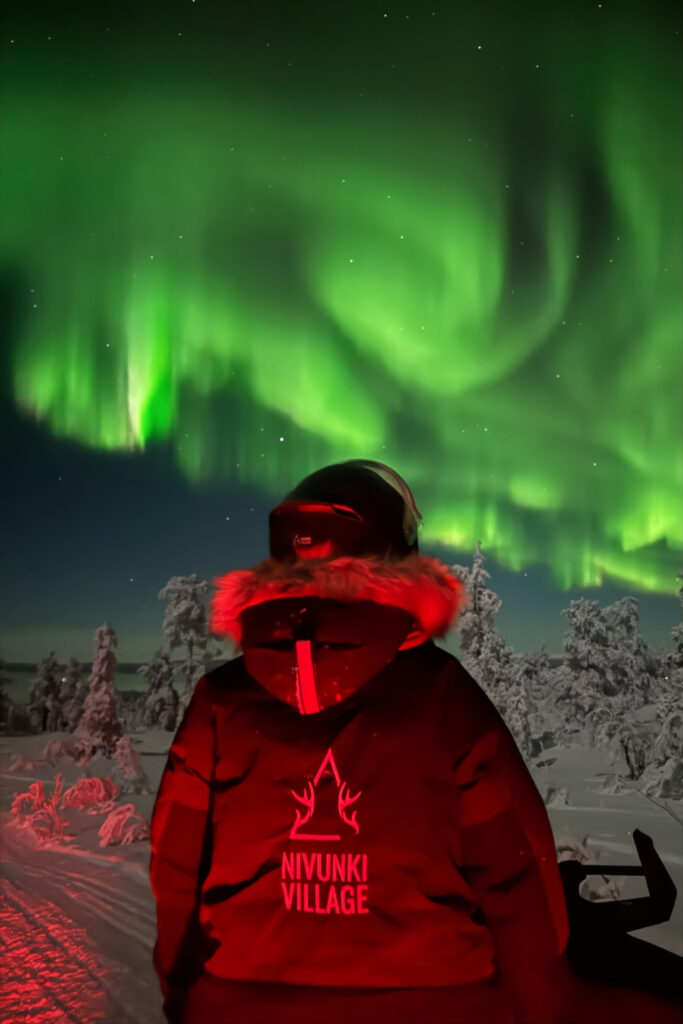
Green is by far the most common Northern Lights colour you will see in Finnish Lapland. It comes from oxygen atoms at roughly 100 to 200 km above the Earth’s surface. Red, also produced by oxygen but much higher up, is very rare. Blue, violet and pink tones come from nitrogen. At Nivunki Village, beside the lake and well away from light pollution, the sky gives you the clearest possible view of whichever northern lights colours the atmosphere is producing on any given night.
Aurora photographs can look almost impossibly vivid, and first-time visitors sometimes wonder whether the real sky will match what they have seen online. The answer depends on several things: the gas involved, the altitude at which it glows, the strength of the solar activity, and how well your eyes have adjusted to the dark. This article works through each colour in turn, explains the atmospheric science behind it, and then connects that knowledge to what you might actually see from the lakeside at Nivunki Village during the winter season, which runs from 14 November 2026 to 3 April 2027.
What colours can the Northern Lights be?
The aurora borealis colours you are most likely to see are green, with red, blue, violet and pink appearing under the right conditions. Each colour is produced by a specific gas at a specific altitude in the atmosphere, and the mix you see on any given night depends on how energetic the incoming solar particles are and how high they penetrate before they collide with gas molecules.
In Finnish Lapland, green dominates. It is what most people picture when they think of the aurora, and it is what most visitors will see. The other colours are real, but they are less frequent and often appear at the edges of a display rather than across the whole sky. Understanding which gas produces which colour is the clearest way to understand why some aurora colours are common and others are not.
For example, a strong display might show a broad green curtain with a faint red fringe at the top and a thin band of pink or purple along the lower edge. Each of those bands is produced by a different gas at a different height, all lit up by the same stream of solar particles passing through the atmosphere.
Why are the Northern Lights green?
Green is the most common aurora colour because oxygen at roughly 100 to 200 km altitude is the gas most frequently energised by incoming solar particles, and green is the wavelength that oxygen emits when it returns to its resting state at that height.
To understand why this matters, it helps to know what is actually happening. When charged particles from the Sun travel along the Earth’s magnetic field lines toward the poles, they collide with gas molecules in the upper atmosphere. Those collisions transfer energy to the gas atoms, exciting them. As the atoms release that energy, they emit light at a wavelength determined by the type of gas and the altitude. Oxygen at 100 to 200 km consistently emits green light, which is why that colour fills so much of the sky during a typical display.
The question “why are the Northern Lights green” has a precise answer: it is oxygen at that particular altitude band doing what physics requires of it. The fact that this altitude range is where solar particles most commonly interact with the atmosphere is why green dominates every aurora season in Lapland, including the roughly 200 aurora nights a year that Finnish Lapland experiences on average across its clear nights.
Red Northern Lights: rare but real
Red northern lights are produced by the same gas as green, which is oxygen, but at a much greater altitude, above approximately 200 km. At that height, the atmosphere is extremely thin, collisions between atoms are infrequent, and the oxygen has more time to emit light at a slower, lower-energy wavelength. That slower emission produces red rather than green.
The rarity of red comes down to energy and altitude. Most solar particle streams do not penetrate deep enough into the atmosphere to energise oxygen at 100 to 200 km in large quantities, but they do interact with the upper atmosphere. However, the conditions needed to produce a vivid red display across a significant portion of the sky require unusually strong solar activity. So while red aurora is real, it is genuinely uncommon, and a full red display is something even experienced aurora watchers may see only a handful of times.
Are red northern lights rare? Yes, in the clearest possible terms. When they do appear, they are often visible at the very top of a green display, as a faint wash rather than a bold band. A deep, widespread red aurora is among the rarer sights in Finnish Lapland, which is precisely why it is worth knowing what to look for and where to position yourself when conditions are strong.
Blue, violet and pink edges
Blue, violet and pink aurora colours come from nitrogen rather than oxygen, and they tend to appear at the lower edges of a display or woven through it when solar activity is strong enough to energise nitrogen molecules alongside oxygen.
Nitrogen at roughly 100 to 200 km altitude emits blue light. Nitrogen lower in the atmosphere, where it is denser and collisions happen differently, produces a reddish-purple to pink glow along the lower edge of the aurora. When these nitrogen tones mix with the green and red produced by oxygen, the result can look violet, pink or even close to white. The aurora borealis colours you see in a complex display are rarely one pure shade; they are the result of several gases glowing at once at slightly different heights.
Pink northern lights, in particular, appear when the lower edge of an active display catches nitrogen lower in the atmosphere. It is a colour that tends to come and go quickly, appearing as a bright fringe before the display shifts. Blue is less visible to the naked eye than green but is often captured clearly in photographs, which is one of the reasons aurora images can look different from what you remember seeing in person.
Why your camera sees more colour than your eyes
One of the most common points of confusion for first-time aurora travellers is the gap between what they expected from photographs and what they see with their own eyes. The explanation lies in how the human eye works in low light, and it is worth understanding before you travel.
In darkness, the eye relies on rod cells rather than cone cells. Rod cells are sensitive to light and motion but are largely insensitive to colour. This means that in a dark sky, even a reasonably vivid aurora can appear as a pale, shifting grey-white glow to the naked eye, while the same display photographed with a long exposure shows strong green or even red. A camera sensor accumulates light over several seconds, gathering far more photons than the eye can process in a single moment, and the result is a saturated image that reflects the true colour of the aurora more accurately than your visual system can in real time.
This does not mean the aurora is disappointing in person. A strong display moves and shifts in ways that no photograph captures. The structure, the speed of the curtains, the way a band can suddenly brighten and spread across the sky: these are things you experience rather than photograph. Understanding why the camera sees more colour than the eye removes a potential disappointment and replaces it with a more honest expectation. When you do see colour clearly with the naked eye, it is a sign of a genuinely active display. For a deeper look at planning around activity levels, our how to read the aurora forecast guide covers the key indicators to watch before you head out.
Northern Lights colours at a glance
The table below summarises the four main aurora borealis colours, what produces each one, the approximate altitude at which they form, and how often you are likely to see them in Finnish Lapland.
| Colour | Caused by | Approximate altitude | How often |
|---|---|---|---|
| Green | Oxygen | About 100–200 km | Most common |
| Red | Oxygen | Above about 200 km | Very rare |
| Blue | Nitrogen | About 100–200 km | Seen as part of the display |
| Pink or purple | Nitrogen lower down, or colours mixing | Lower edge of the aurora | Seen at times |
Frequently asked questions
What colour are the Northern Lights in Finland?
In Finland, and specifically in Finnish Lapland, green is the colour you are most likely to see. It is the dominant aurora colour across the region and appears on the majority of active nights. Pink, violet and blue tones can appear during stronger displays, usually at the lower edges. Red is possible but genuinely rare. What colour are the Northern Lights in Finland on any given night depends on solar activity and atmospheric conditions, both of which vary.
Are red Northern Lights rare?
Yes, red northern lights are rare. They require oxygen to be energised above approximately 200 km altitude, which happens only during periods of stronger-than-usual solar activity. Most aurora displays in Finnish Lapland produce green, and while a faint red fringe at the top of a display is possible during active nights, a vivid red aurora visible across a wide portion of the sky is something even regular aurora watchers see infrequently.
Can the Northern Lights be pink?
Yes. Pink northern lights appear when nitrogen in the lower part of the aurora glows reddish-purple, or when green and red tones from oxygen mix in a way that the eye or camera reads as pink. It tends to show along the lower edge of an active display and can appear and fade quickly. Pink is more visible in photographs than to the naked eye, for the same reasons that all aurora colours are stronger in long-exposure images.
Why do photos of the aurora look brighter than what I see?
A camera set to a long exposure gathers light over several seconds, accumulating far more than the human eye can process at once. In low light, the eye also switches to rod cells, which are sensitive to brightness and movement but not to colour. The result is that photographs often show stronger, more saturated aurora borealis colours than you see in person. This is not a flaw in the photograph; it is an accurate record of the light that was there.
Watching the colours at Nivunki Village
Understanding the science of northern lights colours changes how you watch. You know that green is the baseline, that any red at the top of a display signals a stronger-than-usual night, and that the pink or purple fringe along the lower edge is nitrogen doing something different from the oxygen above it. That knowledge makes a clear sky feel more interesting rather than less.
At Nivunki Village, the conditions for seeing those colours at their clearest are as good as Finnish Lapland offers. The village sits beside the lake about 20 km from Muonio, with no light pollution interfering with the sky. From your 30 m² glass kota, the view is unobstructed. When you want to go further, our guides lead the Aurora Trek in Nivunki on Monday, Wednesday, Friday and Sunday evenings, and the Aurora Snowmobile Tour covers 20 km of the surrounding landscape on the same nights. For something more tailored, the Aurora Hunt is a private three-hour excursion. You can read about all three in detail on our choosing a Northern Lights tour page, or find the full picture of when, where and how to see the Northern Lights in our Northern Lights guide.
The lights do not appear on schedule, and no one can promise a particular colour on a particular night. What we can offer is the right place, the right conditions, and guides who have spent their lives in this landscape. If you are planning a stay during the 2026 to 2027 winter season, plan your aurora nights with our team and we will help you make the most of whatever the sky has to offer.