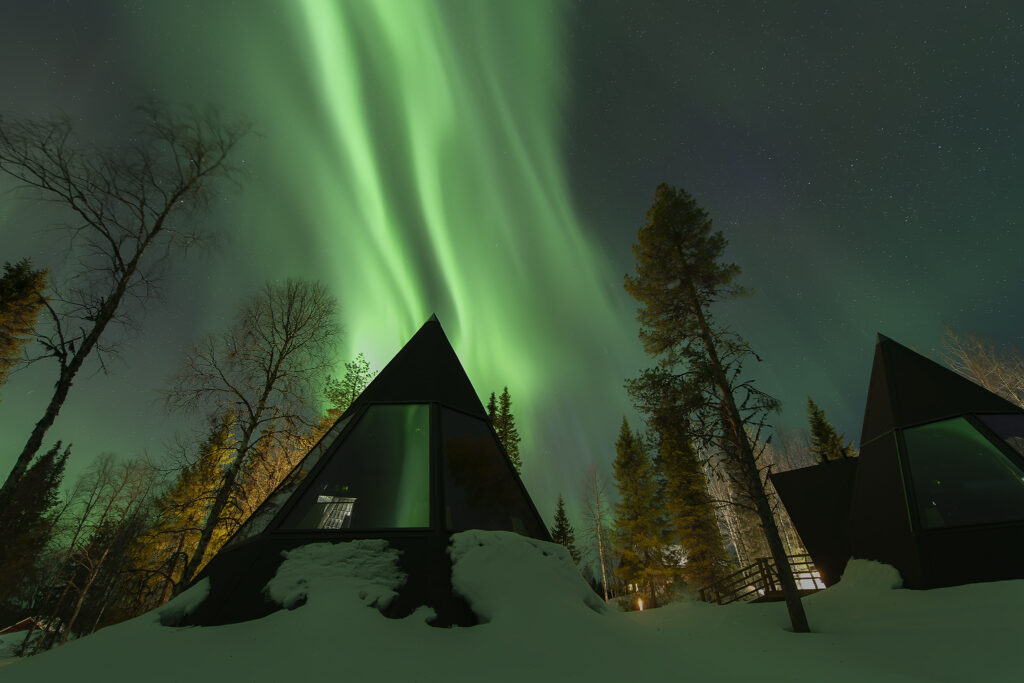
To read a northern lights forecast in Finland, check two things together: aurora activity and cloud cover. A Kp index of 1 to 2 may be enough to see the aurora in northern Lapland, but only a clear, dark sky gives you any chance at all. At Nivunki Village, beside a lake about 20 km from Muonio with no light pollution nearby, those conditions come together as well as anywhere in the region. This guide explains what each layer of the forecast means and how to act on it.
How do you read a northern lights forecast in Finland?
A northern lights forecast in Finland combines two separate signals: geomagnetic activity and sky conditions. Neither is enough on its own. A strong aurora event is invisible through cloud, and a perfectly clear sky shows nothing if the sun has been quiet. Read them side by side, and check again in the evening before you go out, because both can shift quickly.
The Finnish Meteorological Institute publishes aurora and space weather information for Finland, and that is the most reliable domestic source for a northern lights prediction for Finland. Start there, then look at a cloud forecast for your specific location. When both signals look favourable at the same time, that is your window.
For broader context on when, where and how to see the Northern Lights across the season, our full guide covers the conditions in more depth.
What is the Kp index?
The Kp index measures geomagnetic activity on a scale from 0 to 9. A value of 0 means the sun is very quiet; a value of 9 means a severe geomagnetic storm. Higher values produce stronger, more widespread auroras that reach further south and appear brighter and more structured in the sky.
The index is updated every three hours, so it reflects near-real-time conditions rather than a precise prediction. Think of it as a measure of how much energy the sun is currently pushing toward Earth. Green is the most common aurora colour at any Kp level. Red is very rare and typically appears only during the strongest events.
What Kp index do you need to see northern lights in Lapland?
In northern Lapland, a Kp of 1 to 2 may be enough to see the aurora on a clear, dark night. This is lower than many travellers expect. The key reason is latitude: the further north you are, the closer you sit to the auroral oval, the band of sky where geomagnetic activity concentrates. At Nivunki Village, north of the Arctic Circle, even a modest Kp reading can produce visible activity overhead.
That said, a higher Kp value generally means a brighter, more active display that fills more of the sky. A Kp of 4 or above tends to produce the curtain-like formations that move across a wide arc. But waiting only for high Kp readings means missing many of the quieter, greener displays that appear on calm nights when the index sits low. What Kp index do you need to see northern lights in Lapland? In practice, prioritise clear skies first, and let the Kp value tell you how active the display might be.
Why the cloud forecast matters most
Cloud is the single biggest factor determining whether you see the aurora on any given night. An aurora can be active overhead and completely invisible if a layer of cloud sits between you and the sky. This is why experienced aurora watchers check the cloud forecast before they check the Kp index.
Look for clear spells rather than a fully clear night. Even a gap in the cloud for an hour or two can be enough. Conditions in Finnish Lapland can change within minutes, so a forecast that shows partial cloud in the evening may open up by midnight. That is why checking again late in the evening is worth doing.
Darkness matters too. The aurora season in Lapland runs from late August to early April, and the darkest months in Lapland offer the longest windows of true night sky. Artificial light, even from a single bright source, reduces contrast and makes fainter displays harder to see. Nivunki Village is positioned away from town light pollution, which means the sky above the lake is genuinely dark.
Where to check aurora and space weather information
The Finnish Meteorological Institute is the primary source for aurora and space weather information in Finland. It publishes forecasts and real-time geomagnetic data that are specific to the Finnish context, including northern Lapland. Check it when you are planning your evening and again before you step outside.
No forecast tool replaces looking at the actual sky. Conditions on the ground, particularly cloud movement, can differ from what a model predicted a few hours earlier. Use the forecast to decide when to be ready, then use your eyes to decide when to go out.
How far ahead can you trust a forecast?
Aurora forecasts are short-term guidance. The further ahead a prediction reaches, the less reliable it becomes, because geomagnetic activity depends on solar behaviour that is difficult to model with precision. Use forecasts as a reason to be prepared, not as a guarantee of what the night will bring.
The most useful habit is to check the aurora forecast in Lapland in the afternoon, note the Kp expectation and the cloud picture, and then check both again after dinner. The aurora keeps no schedule. Some of the clearest displays appear on nights that looked uncertain at midday. Staying flexible matters more than finding the perfect forecast.
There are roughly 200 aurora nights a year in Lapland, which works out to approximately every second clear night across the season. Over a stay of several nights, the odds of a sighting on at least one of them are reasonably good, provided the sky cooperates.
What to do on a promising night
When the northern lights forecast for Lapland looks favourable and the cloud picture is clear or partly clear, the following steps give you the best chance of a sighting. Act on them early in the evening so you are ready when activity begins.
- Check the cloud forecast again in the evening before committing to a plan
- Dress for standing still: the cold feels sharper when you are not moving
- Turn off bright lights and screens to let your eyes adjust to the dark
- Join a guided aurora trek or snowmobile tour with our team, who know where to position you for the best view of the landscape
- Keep watching from your glass kota between outings, since the panoramic windows let you scan the sky without going outside
Our guided aurora excursions, including the Aurora Trek in Nivunki and the Aurora Hunt, are designed around exactly these conditions. Our guided aurora excursions run on set evenings through the winter season, and the private Aurora Hunt can be arranged for any night when the forecast looks right.
Forecast signals at a glance
Use this table as a quick reference when you are reading the forecast and deciding how to spend your evening.
| Signal | What it tells you | What to do |
|---|---|---|
| Kp value | Expected geomagnetic activity | In northern Lapland, 1 to 2 may be enough |
| Cloud forecast | Whether you will see the sky | Look for clear spells, even brief ones |
| Darkness | Whether the sky is dark enough | Stay away from artificial light sources |
| The sky right now | What is actually happening overhead | Step outside and look up |
Frequently asked questions
What Kp index do you need to see the Northern Lights in Lapland?
In northern Lapland, a Kp of 1 to 2 may be enough on a clear, dark night, because of the region’s proximity to the auroral oval. Higher values, typically Kp 4 and above, tend to produce more vivid and widespread displays. But clear skies matter more than any Kp reading. A Kp of 6 means nothing through a layer of cloud.
Will the northern lights appear tonight?
No forecast can confirm that the Northern Lights in Lapland today will be visible tonight. Forecasts indicate geomagnetic conditions, but cloud cover, local weather and the aurora’s own unpredictability all play a role. Check the Finnish Meteorological Institute for current space weather data, look at the cloud picture for your location, and then be ready to go outside when the sky clears.
Where can I check the aurora forecast in Finland?
The Finnish Meteorological Institute publishes aurora and space weather information for Finland. It is the most reliable domestic source and covers geomagnetic activity specific to Finnish Lapland. Check it in the afternoon for an overview, then again in the evening before you head out, as conditions can change significantly over a few hours.
Can you see the Northern Lights with a low Kp?
Yes. In northern Lapland, a Kp of 1 or 2 can produce a visible aurora on a clear, dark night. The displays at low Kp tend to be quieter, often a steady green arc rather than moving curtains, but they are real and worth watching for. The combination of a dark sky and no light pollution, as at Nivunki Village, makes low-Kp displays easier to see.
Aurora nights at Nivunki Village
Nivunki Village is open for the winter season from 14 November 2026 to 3 April 2027. The village sits beside a lake, about 20 km from Muonio, away from town light pollution. Each 30 m² glass kota lets you watch the sky from inside, and the sauna with panoramic windows means that even a sauna session can double as an aurora watch.
We run several guided aurora experiences through the season. The Aurora Trek in Nivunki covers 3 km on foot over two and a half hours, departing Monday, Wednesday, Friday and Sunday at 20.00. The Aurora Snowmobile Tour covers 20 km over two hours on the same evenings. For a longer outing, the Northern Lights Snowmobile Tour to Fell Särkitunturi runs for four hours on Tuesday, Thursday and Saturday evenings. The Whispers of the Aurora at Old Mill Äkäsmylly is a three-and-a-half-hour experience on the same nights. For something private, the Aurora Hunt runs for three hours and can be arranged to suit your schedule.
Our guides grew up in this landscape. They know where to position you for the clearest view and how to read the sky as the night moves on. For a complete overview, our Northern Lights guide covers the full picture of what to expect across the season. When you are ready to plan the details, plan your aurora nights with our team and we will help you find the right evenings for your stay.