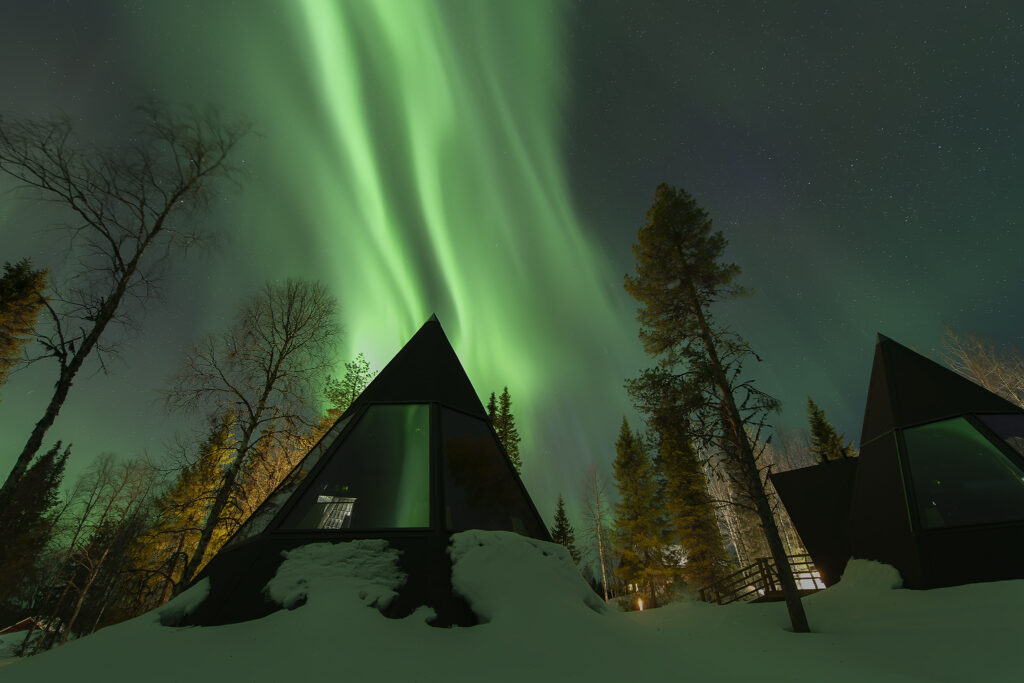
Kaamos is the Finnish word for the polar night, the midwinter period above the Arctic Circle when the sun does not rise above the horizon at all. It is rarely pitch black. Blue twilight fills the middle of the day, the moon reflects off snow-covered ground, and the long, dark nights give the Northern Lights hours to move across the sky. Nivunki Village, situated beside a lake about 20 km from Muonio in Finnish Lapland, sits north of the Arctic Circle, placing it squarely within kaamos country each winter.
If you are planning a winter trip and wondering whether polar night Lapland is simply too dark to enjoy, this guide works through the reality of kaamos step by step. You will learn what the polar night actually is, how long it lasts and where it occurs, what light the season does offer, and how to make the most of the long, quiet hours. For a broader look at what each winter month is like in Lapland, the full seasonal guide covers everything from November through April.
What is the polar night?
The polar night, known in Finnish as kaamos, is the period during which the sun remains below the horizon for the entire day. It occurs only above the Arctic Circle, where the tilt of the Earth means that in midwinter the sun never climbs high enough to appear in the sky at all. The word kaamos carries a particular cultural weight in Finland: it describes not just an astronomical event but a season with its own rhythm, light quality, and feeling.
A common misconception is that kaamos means total darkness around the clock. That is not accurate. Even when the sun is below the horizon, sunlight still reaches the upper layers of the atmosphere, allowing some ambient light to filter through. The result is a distinctive twilight glow rather than continuous night. The moon, when it is out, brightens the landscape further, and snow on the ground reflects whatever light is available, giving the outdoors a soft, diffuse luminosity that is unlike anything in southern latitudes.
For aurora seekers, kaamos is not a problem to work around. It is an advantage. The long nights mean more hours of darkness, and more hours of darkness mean more time for the Northern Lights to appear.
Where kaamos happens in Finland
The polar night in Finland is a phenomenon of the north. It only occurs above the Arctic Circle, which cuts across Finnish Lapland. South of that line, including in Helsinki, there is no polar night at all. Helsinki’s shortest day in December is under six hours long, which can feel dim, but the sun does rise and set each day throughout the year.
Muonio, the nearest town to Nivunki Village, lies north of the Arctic Circle. That means guests arriving during the winter season are arriving in genuine kaamos territory, where the sun’s absence is a real and daily fact of life rather than a southern approximation of it. The farther north you travel within Lapland, the more pronounced and extended the polar night becomes, as the next section explains.
How long does the polar night last?
The duration of kaamos depends entirely on latitude. The farther north you are, the longer the sun stays below the horizon. This is one of the most important things to understand about the polar night in Lapland: it is not a single fixed period but a spectrum that changes with every degree of latitude.
At Sodankylä, which sits close to the Arctic Circle in southern Lapland, kaamos lasts only around four days. At Utsjoki, on Finland’s northern border, it extends for almost two months. These two examples illustrate how dramatically the experience changes across Finnish Lapland’s geography. A traveller arriving in early December to a location near the Arctic Circle will experience something quite different from someone spending three weeks in the far north.
Because Muonio lies north of the Arctic Circle, guests at Nivunki Village during the heart of winter are in genuine polar night. We do not state an exact duration for Muonio, because kaamos length shifts with precise latitude and the calendar, but the midwinter weeks around December and January bring the darkest conditions and the longest nights.
Is it dark all day? The blue twilight
This is probably the question most travellers ask before their first winter visit to Finnish Lapland: is it dark all day in Lapland? The honest answer is no, not in the way most people imagine. Kaamos does not mean standing in complete blackness from morning until night.
What actually happens is this. Around midday, even when the sun is below the horizon, the sky brightens into what is known as Lapland’s blue twilight: a soft, cold luminosity that sits between blue and violet, lasting for an hour or two before fading again. The colour is unlike anything produced by a standard sunrise or sunset. It is even and sourceless, as though the sky itself is glowing rather than being lit from a single point. Snow on the ground catches and amplifies this light, so the landscape is far from invisible.
On 22 December, the winter solstice, the sun rises for a few minutes on the Arctic Circle itself before dipping back below the horizon. North of the Circle, it does not appear at all, but that midday twilight still arrives. The moon plays its part too. On clear nights with a full or near-full moon, the snow-covered lake and forest around Nivunki Village reflect enough light to move through the landscape without a torch.
The blue twilight is worth planning around. Stepping outside at midday gives you a window of gentle, photogenic light that is genuinely beautiful and unlike anything available in the months either side of kaamos. It is brief, which makes it worth seeking out rather than sleeping through.
Northern Lights during kaamos
The polar night and the Northern Lights are connected in a straightforward way: kaamos provides the long, dark skies that aurora activity needs to be visible. Seeing the Northern Lights requires darkness, and kaamos delivers it in abundance.
According to Finavia, Lapland sees aurora activity on around 200 nights a year, which works out to roughly every second clear night. The Finnish Meteorological Institute notes that the best viewing window is typically between 21.00 and 01.00 local time, when geomagnetic activity tends to peak. Clear skies are the single biggest factor. No aurora sighting can be guaranteed, but the conditions in Finnish Lapland during kaamos are among the most favourable on Earth.
At Nivunki Village, the glass kotas sit beside the lake away from the light pollution of resort centres, which matters more than most travellers realise. Even modest light pollution from a nearby town can wash out the fainter aurora displays. Our guides lead the Aurora Trek in Nivunki, a 2.5-hour walk departing at 20.00 on Mondays, Wednesdays, Fridays, and Sundays, timed for the peak viewing hours. For those who prefer to watch from warmth, our sauna has panoramic windows and sauna sessions can coincide with aurora viewing. For guidance on interpreting the forecast before you travel, reading the aurora forecast is a practical skill worth developing.
How to enjoy the polar night
Kaamos rewards travellers who adapt to its rhythm rather than fighting it. The key is to treat the season on its own terms: the blue twilight, the long evenings, the quiet and the cold each offer something that no other season does.
- Step outside at midday for the blue twilight, when the sky is at its most atmospheric
- Plan sauna rounds for the long evenings, when the darkness and warmth work together
- Watch for the aurora between 21.00 and 01.00, the peak window for Northern Lights activity
- Take a gentle snowshoe walk in the soft midday light, such as the Nivunki Winter Wonders trail
- Dress warmly for standing outside, especially during aurora watches when you may be still for long periods
- Let the slower pace set your day rather than filling every hour
For a closer look at how the season unfolds week by week, the guide to the festive weeks in Lapland covers December and January in Lapland in detail, including what to expect from the light and the weather.
Polar night at a glance
The table below shows how the duration of kaamos varies across Finland, from the far north to the south.
| Place | Polar night |
|---|---|
| Utsjoki (northern border) | Almost two months |
| Sodankylä (near the Arctic Circle) | Four days |
| The Arctic Circle | The sun rises for a few minutes on 22 December |
| Helsinki | No polar night; the shortest day is under six hours |
Frequently asked questions
What is kaamos?
Kaamos is the Finnish word for the polar night, the period in midwinter when the sun does not rise above the horizon. It occurs only above the Arctic Circle. The word also carries a cultural meaning in Finland, describing the particular quality of the season: its stillness, its blue light, and the way daily life slows and adjusts to the dark. It is not simply an absence of sun but a season with its own character.
Is it dark all day in Lapland in winter?
Not completely. Even during the polar night, sunlight reaches the upper atmosphere and produces a soft blue twilight around midday. This glow lasts an hour or two and gives the landscape a distinctive, cold luminosity. Snow on the ground reflects the available light, and on clear nights the moon brightens the scene further. Kaamos is dim and short on daylight, but it is not the unbroken darkness most people picture.
How long is the polar night in Lapland?
It depends on where in Lapland you are. Near the Arctic Circle, in places like Sodankylä, kaamos lasts around four days. At Utsjoki on Finland’s northern border, it extends for almost two months. The polar night in Finland is not a single fixed period but a range that shifts with latitude. Locations north of the Arctic Circle experience longer kaamos than those sitting right on the line.
Can you see the Northern Lights during the polar night?
Yes, and kaamos is one of the best times to try. The long nights provide extended hours of darkness, which is exactly what aurora viewing requires. Finavia estimates around 200 aurora nights per year in Lapland. Clear skies are the decisive factor, and no sighting can be guaranteed. At Nivunki Village, a glass kota beside the lake, away from light pollution, puts you in a strong position when the sky cooperates.
Kaamos at Nivunki Village
Polar night Lapland is not something to endure. At Nivunki Village, kaamos is the season the place is built for. The adults-only glass kotas, each 30 m² with a king-size bed and a view across the frozen lake, sit in darkness deep enough to let the aurora fill the sky when conditions allow. Breakfast and premium winter clothing are included. The sauna with panoramic windows is there for the long evenings. Our guides, who grew up in this landscape, lead aurora treks timed for the hours when the lights are most likely to appear.
The winter season runs from 14 November 2026 to 3 April 2027. If you would like to talk through the best time to visit or what to expect from the kaamos weeks, plan your winter stay with our team and we will help you find the right moment.